

E-commerce has become today the fastest engine for business growth in the Kingdom, and the Salla platform represents one of the strongest gateways to entering this world. However, to ensure a legal and successful launch, it is essential to be fully aware of all official and technical requirements. In this article, we present a comprehensive guide to the requirements for opening a store on Salla, helping you build your project on solid foundations that ensure continuity and competitiveness.
Requirements for Opening a Store on Salla
The establishment phase and meeting legal and technical requirements are only the first step. The real challenge lies in standing out among competitors and achieving sustainable sales. Steps Grow is your ideal partner to shoulder this responsibility on your behalf. We provide integrated digital marketing solutions that start with helping you open and set up your store, and extend to strengthening your digital presence and attracting customers to increase your sales locally and globally.
1. Legal and Sharia Eligibility of the Merchant
The applicant must have full legal and Sharia-recognized capacity, granting them the right to independently enter into contracts and financial and commercial obligations.
2. Compliance with Local Regulations and Laws
The store’s activity must comply with the laws of the Kingdom of Saudi Arabia. The merchant must clearly disclose the nature of the products or services offered and ensure they do not violate public morals or public order.
3. Legitimacy of the Products and Services Offered
The merchant acknowledges that all items traded through the store do not violate the platform’s usage policies or applicable regulations in the Kingdom, and the platform reserves the right to reject any activity that does not align with its policies.
4. Integrity of the Merchant’s Legal Record
Opening a store is not permitted for anyone whose membership or store was previously terminated by Salla for disciplinary reasons, or for those against whom court rulings prohibit the practice of commerce.
5. Commitment to the Legal Entity of Establishments
When registering as a company, institution, or legal entity (such as a charitable organization), the entity must comply with all clauses of the usage agreement and bear full legal responsibility for its transactions.
6. Adherence to Digital and Commercial Legal Frameworks
All merchants must comply with the E-Commerce Law, the Cybercrime Law, the regulations of the Ministry of Commerce and Investment, and all bylaws governing electronic transactions in the Kingdom.
7. Transparency and Disclosure of Contact Information
The store must clearly display its official details to consumers, including (name, address, commercial registration number or freelance document, and official contact methods).
8. Drafting Legal Store Policies
The merchant must provide a clear privacy policy and terms and conditions governing the relationship between the merchant and the consumer, as these policies are treated as binding electronic contracts.
9. Issuing Invoices and Regulating Return Policies
The merchant is required to provide the buyer with a detailed electronic invoice that includes (product price, service fees, delivery date and location), along with a clear explanation of exchange and return policies.
10. Obtaining Specific Licenses
For businesses offering products that require special authorization (such as medical or food products), the necessary government licenses must be disclosed and their details shared on the store.
11. Linking to the Official Commercial System
If the store has a physical outlet and an existing commercial registration, the online store must be registered under the same commercial record to ensure legal credibility.
12. Declaration of Readiness of Official Requirements
Before starting the registration process, the merchant confirms that all procedures and requirements requested by government authorities to practice their commercial activity have been fulfilled lawfully.
13. Basic Technical and Banking Requirements
A valid commercial registration or freelance document is required, in addition to an active Absher account, an active Saudi bank account, and a Saudi mobile number to complete the linkage and store verification.
14. Requirements for Individual Merchants (Natural Persons)
Individuals must provide their national ID and freelance document and acknowledge their responsibility for submitting all documents required by the platform and official authorities according to their field of work.
15. Verification of Legal Entities
Companies and institutions must provide the platform with all supporting documents, such as the commercial registration, authorization papers, and any additional documents requested by Salla to verify legal identity.
16. Compliance with Account and Registration Obligations
The merchant must follow all steps specified in the “Accounts” section of the usage agreement, ensure the accuracy of the submitted information, and update it continuously.
17. Platform Monitoring and Enforcement Rights
The platform reserves the right to take actions (such as warnings or closure) in case of violations, while disclaiming responsibility for the direct relationship between the merchant and the consumer.
18. Activation of Technical Communication Channels
Having an active email address and a working phone number is a fundamental requirement, as verification codes and official notifications are sent through them to ensure account security.
19. Disclaimer of Commercial Losses
The merchant agrees that Salla is a “technical service provider” and bears no responsibility for any financial or commercial losses the store may incur as a result of its activity.
20. Consideration of Societal and Islamic Values
It is prohibited to display any products that violate Islamic values or societal standards in the Kingdom. All offerings must adhere to general standards of respect.
21. Cybersecurity and Data Protection Standards
The store must apply the highest privacy standards to ensure the safety of customer data and protect it from breaches, in line with Saudi e-commerce requirements.
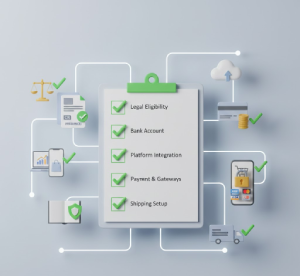
22. Integration with Payment and Shipping Gateways
The merchant is required to provide secure electronic payment methods approved by the central bank, in addition to offering reliable shipping and delivery services that meet required quality standards.
Can I Open a Salla Account Without a Commercial Registration?
Yes, you can. The Salla platform allows individuals and aspiring entrepreneurs to use alternative options instead of a formal commercial registration, including:
-
Freelance Work Document
-
Productive Families Certificate
-
National ID
What Are the Requirements for Opening an Online Store?
-
Official identification
-
Legal coverage
-
Bank account
-
Electronic verification
-
Technical tools
-
Special licenses
From Setup to Sales… Steps Grow Is Your Partner at Every Stage
Launch your store toward the top with Steps Grow! Overcome the complexities of setup and focus on growing your business. Steps Grow handles all procedures on your behalf and provides integrated marketing solutions that ensure customer attraction and increased sales locally and globally.
Contact us now and start your success story with your ideal marketing partner!