
Build an Ecommerce Growth System That Produces Revenue, Not Just Traffic
If you are looking for an Ecommerce Marketing Company in UAE, you probably do not need another team that simply launches ads, posts content and sends screenshots at the end of the month. You need a connected growth system that understands how shoppers discover your products, what makes them buy, where revenue leaks from your funnel and which channels deserve more investment.
Steps Grow connects ecommerce SEO, Google and Meta advertising, product feeds, category architecture, conversion optimisation, analytics, product-page strategy and customer retention around one commercial objective: acquiring profitable customers and increasing the value your store generates from the traffic it already receives.
Ecommerce Growth Diagnostic
Answer eight questions and get an instant growth-readiness score with practical priorities for your store.
Your Product Is Not Competing Alone — Your Entire Buying Experience Is
UAE shoppers can compare competing stores, marketplaces, delivery promises, payment options, reviews and prices within minutes. Winning therefore requires more than reaching the customer. Your store also has to reduce uncertainty and make the purchase feel easier than the alternatives.
Arabic and English Search Behave Differently
An Arabic shopper and an English-speaking shopper may describe the same product in completely different ways. Literal translation therefore misses search demand. We research and structure each language around the way its audience actually searches and buys.
Paid Acquisition Cannot Carry the Entire Business
Advertising provides speed, but a store that depends entirely on paid traffic starts paying again for every new customer. SEO, repeat purchases, email, WhatsApp and direct demand can gradually reduce that dependency.
Conversion Experience Is Part of Marketing
Shipping information, returns, mobile speed, payment methods, product photography, stock status, reviews and checkout friction can determine whether the same click becomes a purchase or a bounce.
This is why a serious Ecommerce Marketing Company in UAE should not begin with the question, “How much do you want to spend on ads?” The first question should be: where is the greatest commercial opportunity right now? More qualified traffic may be the answer—but sometimes the fastest growth comes from converting existing visitors better or increasing repeat purchase.
Everything Your Store Needs From Discovery to Repeat Purchase
Individual channels can be useful, but ecommerce growth becomes much stronger when acquisition, conversion and retention are measured as one customer journey.
Ecommerce SEO
Commercial keyword research, category architecture, product pages, technical SEO, internal linking, duplicate-content management and Arabic/English organic search strategy.
Explore our SEO services .
Performance Advertising
Google Search, Shopping, Performance Max, Meta and other suitable channels structured around product economics, purchasing intent and measurable conversions rather than reach alone.
See our paid advertising services .
Product Feed & Merchant Readiness
Product titles, identifiers, pricing, availability, imagery and feed quality influence how effectively products can be understood and promoted across shopping environments.
Conversion Rate Optimisation
We analyse product pages, cart, checkout, mobile UX, trust signals and purchase friction to identify why part of your existing traffic does not convert.
Product Page Optimisation
Product messaging, specifications, imagery, variants, related items, FAQs and purchasing information are shaped around the questions a shopper needs answered before buying.
Category & Collection Growth
High-value categories become commercial landing pages with clear search intent, useful navigation, supporting context and stronger links into the products that matter most.
Retention & Repeat Purchase
Abandoned-cart journeys, post-purchase communication, replenishment opportunities, cross-selling and customer segmentation can increase value without paying full acquisition cost every time.
Analytics & Attribution
GA4, conversion events and platform tracking should help you understand which landing pages, campaigns and audiences produce actual orders—not simply clicks.
Ecommerce UX & Store Development
When growth is limited by the store itself, we look at architecture, mobile usability, speed and conversion paths rather than trying to solve a website problem with more ads.
Explore our website and ecommerce design services .
Measured Growth Is More Useful Than Marketing Promises
Rather than rely only on claims, these selected Google Search Console screenshots show real organic search performance from Steps Grow work. They demonstrate what sustained technical, content and search optimisation can build over time.
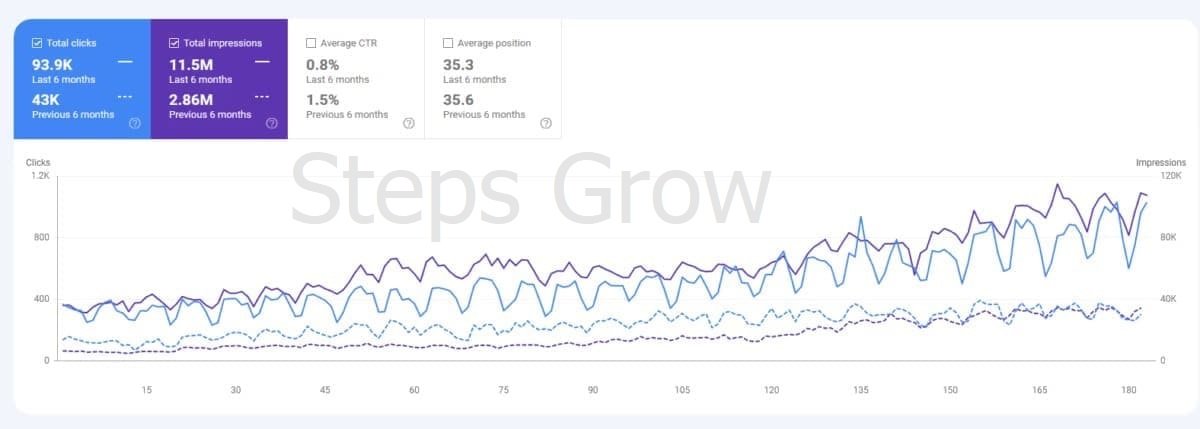
Organic Visibility That Compounds
The screenshot shows a sustained increase in search visibility across the measured period. For an ecommerce brand, the strategic objective is to connect this kind of organic discovery with commercial categories and products rather than chase traffic for its own sake.
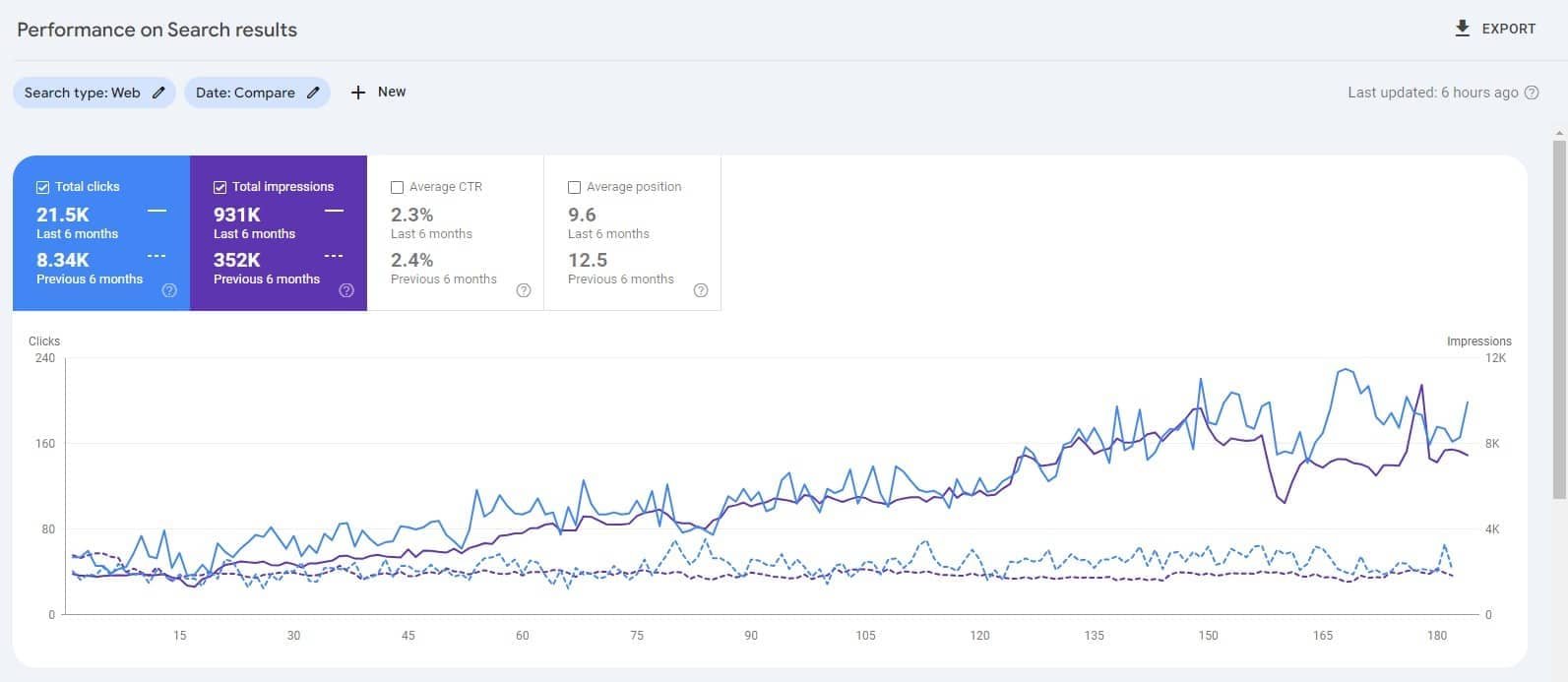
Growth Across Consecutive Periods
Search performance becomes commercially useful when the pages gaining visibility are connected to buying intent, conversion tracking and a clear customer journey.
Where Is Your Store Losing the Most Growth?
More traffic is not always the answer. Select the area you suspect is limiting growth and see what should be investigated before more budget is committed.
Model the Impact of Better Traffic and Better Conversion
Adjust your current sessions, conversion rate, order value, gross margin and assumed improvement. The calculator shows how small changes across several parts of the funnel can combine into a much larger commercial difference.
Your Illustrative Growth Scenario
*Planning model only. It is not a forecast or guarantee and does not include refunds, fulfilment, tax, overhead, payment fees, repeat purchasing or other commercial variables.
The Problems Shoppers Never See Can Still Stop Google Finding Your Best Products
Ecommerce websites can generate large numbers of URLs through filters, variants, tags, sorting, internal search and pagination. Without deliberate crawl and indexation rules, important product and category pages can become harder to discover and interpret.
Faceted Navigation
Price, colour, size, brand and other filters can produce huge URL spaces. We identify which filtered pages deserve search visibility and which should not consume unnecessary crawling.
Category Architecture
Categories, subcategories and product relationships are organised so important products can be discovered through normal crawlable links rather than depending on search boxes or JavaScript interactions alone.
Canonicals & Duplicate URLs
Product variants, alternate paths and query parameters can create competing versions of the same commercial page. We review canonicalisation and internal linking around the preferred destination.
Out-of-Stock Products
Not every unavailable product should be deleted. The correct action depends on whether stock will return, whether an equivalent replacement exists and whether the URL retains organic demand or backlinks.
Product Structured Data
Eligible product, offer, pricing, availability and review information should accurately reflect what the shopper can actually see. Structured data is used to clarify information, not invent it.
Mobile Performance
Large imagery, third-party applications, tracking scripts and themes can make stores heavy. We review performance without removing functionality customers genuinely need.
Internal Linking
Navigation, breadcrumbs, related products, buying guides and contextual links should reinforce the commercial hierarchy of the store and make strategic pages easier to reach.
Product & Category Content
Priority pages need enough differentiated information to help shoppers and search engines understand why the page is useful rather than repeating generic manufacturer descriptions.
International & Bilingual SEO
Arabic and English pages need clean relationships, appropriate hreflang where applicable, and language-specific keyword mapping rather than direct translation of one search strategy.
Learn more about our complete ecommerce and technical SEO services .
Ads Should Support the Customer Journey — Not Just Generate Clicks
Different campaign types serve different roles. Search can capture existing intent, Shopping can expose products directly, paid social can create demand, and retargeting can reconnect with visitors who need more time before purchasing.
Search Campaigns
Capture shoppers actively searching for products, brands or commercial solutions with keyword structures and landing pages aligned to the exact intent behind the query.
Shopping & Product Campaigns
Product feeds, accurate pricing, availability and strong imagery create the foundation for shopping-led acquisition where the platform and market make it appropriate.
Behaviour-Based Retargeting
Someone who viewed a product, added to cart or returned several times should not always receive the same message as a cold visitor who has never seen the brand before.
See how Steps Grow approaches paid advertising management across Google, Meta and other suitable channels.
Modern Ecommerce Search Still Starts With Strong Fundamentals
Shoppers can now discover products through traditional search, AI-supported results and conversational research. We do not treat this as a separate collection of “AI hacks.” We strengthen the same foundations that make a store easy to crawl, understand and trust.
What We Do Not Build Around
- Fake “AI schema” or invented machine-readable markup.
- Hundreds of mass-generated pages with minimal differentiation.
- Keyword repetition written for an SEO scoring tool.
- Fabricated reviews, claims or product attributes.
- Promises that a specific AI system will mention your brand.
What We Strengthen Instead
- Accurate product and merchant information.
- Useful category and product-page content.
- Crawlable internal links and logical architecture.
- Original buying guides and meaningful comparisons.
- Structured data that matches visible content.
- Strong page experience across mobile and desktop.
Shopify, WooCommerce and Custom Stores Need Different Execution
We do not recommend rebuilding a store simply because it uses a particular platform. We first identify whether the current platform can support the required SEO, analytics, conversion and catalogue needs.
Shopify has its own URL and application considerations. WooCommerce offers flexibility but can create taxonomy, performance and plugin issues. Larger custom or headless stores may require closer coordination between SEO strategy and development.
Dubai, Abu Dhabi and Sharjah Do Not Automatically Need Duplicate Pages
A store selling nationwide does not necessarily need a separate SEO landing page for every emirate. Location targeting becomes useful when something meaningful actually changes: delivery, stock, stores, collection points, availability or another part of the buying experience.
We also treat Arabic and English as two search behaviours, not as two versions of the same keyword list. This helps build a cleaner multilingual structure while reducing unnecessary page duplication.
Your Cheapest Next Order May Come From Someone Who Already Bought
Ecommerce growth becomes expensive when every month begins with the same requirement: acquire every customer again from paid media. Retention helps the business capture more value from the customers and first-party data it already owns.
Cart Recovery
Follow-up journeys can remind qualified shoppers who showed strong purchasing intent but did not complete checkout.
Post-Purchase Journeys
Confirmation, education, product-care guidance and relevant next-purchase opportunities improve the customer experience after the transaction.
Repeat Purchase
Replenishment cycles and purchase history can help identify when an existing customer may realistically need the product again.
Customer Lifetime Value
Acquisition decisions become more useful when you understand not only the value of the first order, but the potential value of the customer relationship.
Six Steps From Store Diagnosis to Scalable Growth
More channels do not automatically create more growth. We start by identifying the constraint, then prioritise the work most likely to improve the commercial system.
Audit the Store and Data
Review acquisition channels, SEO, product pages, categories, mobile performance, checkout, analytics and existing campaign structure.
Analyse Buyers and Competitors
Understand how customers search, compare and purchase while identifying where competitors are stronger and where they leave useful gaps.
Find the Main Growth Constraint
Determine whether the immediate problem is visibility, traffic quality, conversion, acquisition cost, product feed quality or customer retention.
Build a Prioritised Roadmap
Separate immediate opportunities from longer-term assets and sequence the work according to commercial impact rather than task volume.
Execute and Test
Implement changes in a way that allows performance to be evaluated rather than changing every variable at once.
Measure, Learn and Scale
Increase investment where evidence supports it, improve weak areas and continuously look for the next constraint limiting profitable growth.
Ecommerce Marketing Requires More Than Managing Ad Accounts
| Area | Activity-First Marketing | Steps Grow Ecommerce Approach |
|---|---|---|
| Success Metric | Reach, clicks and engagement | Orders, conversion, CAC, revenue and customer value |
| SEO | Blog production | Categories, products, technical SEO and buyer-intent content |
| Paid Media | Increase spend when results slow | Examine economics, feed, creative, targeting and conversion first |
| Product Page | Usually outside marketing scope | A central part of SEO, CRO and paid-media performance |
| Measurement | Platform dashboard only | Analytics, conversion events and commercial outcomes |
| Languages | Translate the same copy | Independent Arabic and English search and content strategy |
| Growth Model | Keep buying new traffic | Acquisition + CRO + organic growth + retention |
This Is Likely a Good Fit If…
- Your store already receives traffic but growth feels inefficient.
- Paid acquisition costs are rising.
- You want SEO to become a meaningful acquisition channel.
- You have traffic but conversion remains weak.
- You cannot confidently identify which channels create your best customers.
- You want to increase repeat purchasing and customer value.
- You want Arabic and English growth strategies for the UAE market.
We May Not Be the Right Fit If…
- You expect guaranteed rankings or guaranteed sales.
- No changes can be made to the store or customer experience.
- Conversion tracking cannot be implemented or reviewed.
- Commercial performance data cannot be shared with the team.
- You want campaigns launched without examining whether the offer or store is ready.
We Look at the Store as a Revenue System, Not a Collection of Marketing Channels
A campaign can have an excellent click-through rate and still be commercially weak. A product can rank well and still convert poorly. A strong first-order ROAS can still hide a retention problem. The value comes from understanding how the pieces work together.
Data Before Assumptions
We use search demand, analytics, campaign performance and commercial context to decide what deserves priority.
One Connected Customer Journey
SEO, paid media, product pages and retention support the same journey instead of being managed as unrelated activities.
Commercial Measurement
We care about what traffic and campaigns ultimately contribute to enquiries, orders and sustainable acquisition—not how busy the monthly report looks.
Learn more about Steps Grow and our methodology .
Questions UAE Ecommerce Brands Ask Before Investing in Growth
What should I look for in an Ecommerce Marketing Company in UAE?
Look for a team that can connect acquisition with what happens after the click. Ecommerce marketing should include an understanding of SEO, paid media, product pages, conversion, analytics and customer retention rather than evaluating each channel in isolation.
Do you provide ecommerce SEO in the UAE?
Yes. Ecommerce SEO can include keyword mapping, category architecture, product-page optimisation, internal linking, crawl and indexation management, structured data, technical SEO and content designed around commercial search intent.
Can you work with Shopify stores?
Yes. Shopify work can involve collections, product pages, duplicate paths, variants, applications, performance, structured product information, content and internal linking depending on the specific store.
Do you work with WooCommerce?
Yes. WooCommerce projects may involve product and category architecture, WordPress taxonomies, attributes, plugins, performance, canonicalisation, indexing and conversion experience.
Do you manage Google Shopping and ecommerce advertising?
We can structure ecommerce paid campaigns around the platforms and formats appropriate to the store, including Google Search, Shopping-related campaign types and paid social, supported by accurate product and conversion data.
Is SEO or paid advertising better for an online store?
They solve different problems. Paid advertising creates faster visibility while budget is active, while SEO builds organic discovery over time. Many ecommerce businesses use both: paid media for speed and testing, and SEO for a more durable acquisition asset.
Can sales improve without increasing ad spend?
Sometimes. If traffic is already sufficient but conversion is weak, improving product pages, mobile experience, checkout, trust and retention may create more commercial value than simply buying additional traffic.
How long does ecommerce SEO take?
There is no universal timeframe. Results depend on technical condition, competition, domain history, catalogue size and existing authority. Some technical improvements can be processed relatively quickly while competitive commercial categories usually require sustained work.
Can you guarantee a specific ROAS or number-one Google ranking?
No responsible company can guarantee a fixed sales number or permanent Google position because performance also depends on pricing, products, competition, website experience, customer demand and external platform changes. What can be controlled is the quality of strategy, tracking, execution, testing and optimisation.
Do we need separate Arabic and English strategies?
Usually yes. Search wording, persuasive language and buying behaviour can differ by audience. We prefer researching and writing each language for its own user rather than simply translating one finished page into the other.
Can you help a new ecommerce store?
Yes, although the priorities may be different. A new store often benefits from setting up analytics, category architecture, technical SEO, product-page standards and a focused acquisition channel before trying to scale across many platforms simultaneously.
How do you measure ecommerce marketing performance?
Depending on available data, useful metrics can include orders, revenue, conversion rate, acquisition cost, return on ad spend, organic clicks, commercial landing-page performance, repeat purchase rate and customer value.
Before You Spend More, Find Out Where Your Store Is Losing Growth
If you need an Ecommerce Marketing Company in UAE that connects SEO, paid media, product feeds, conversion, analytics and retention instead of treating them as separate services, start by showing us your current store and the numbers you already have.
We will help identify whether the next opportunity is more qualified traffic, better conversion, more efficient acquisition or stronger customer retention—and build the growth priorities from there.